Can Large-Scale Health Data Reveal Hidden Biology in Fibromyalgia?
Exploring the hidden biology of fibromyalgia through electronic health records

Fibromyalgia is one of the most poorly understood chronic conditions in medicine.
Patients experience chronic widespread pain, fatigue, sleep disturbances, cognitive symptoms, headaches, gastrointestinal complaints, and a wide range of other symptoms that can severely impair quality of life. Yet despite affecting millions of people worldwide, the biology underlying fibromyalgia remains poorly understood.
For decades, fibromyalgia was often framed primarily as a disorder of pain perception or central sensitization. But large-scale medical data are increasingly revealing that the condition is associated with measurable systemic physiologic abnormalities extending far beyond pain alone.
Over the past several years, our group has been studying fibromyalgia using nationwide electronic health records, attempting to better characterize the biology and medical comorbidities associated with the disease.
In one of our recent studies, we examined infectious diseases in more than 9,000 fibromyalgia patients compared to over 46,000 matched controls from a nationwide healthcare system in Israel.
The findings were striking.
Fibromyalgia patients showed significantly increased rates of a wide range of infectious diseases, including upper respiratory infections, pneumonia, influenza, sinusitis, urinary tract infections, cellulitis, fungal infections, candidiasis, Helicobacter pylori infection, COVID-19, and cytomegalovirus (CMV) infections.
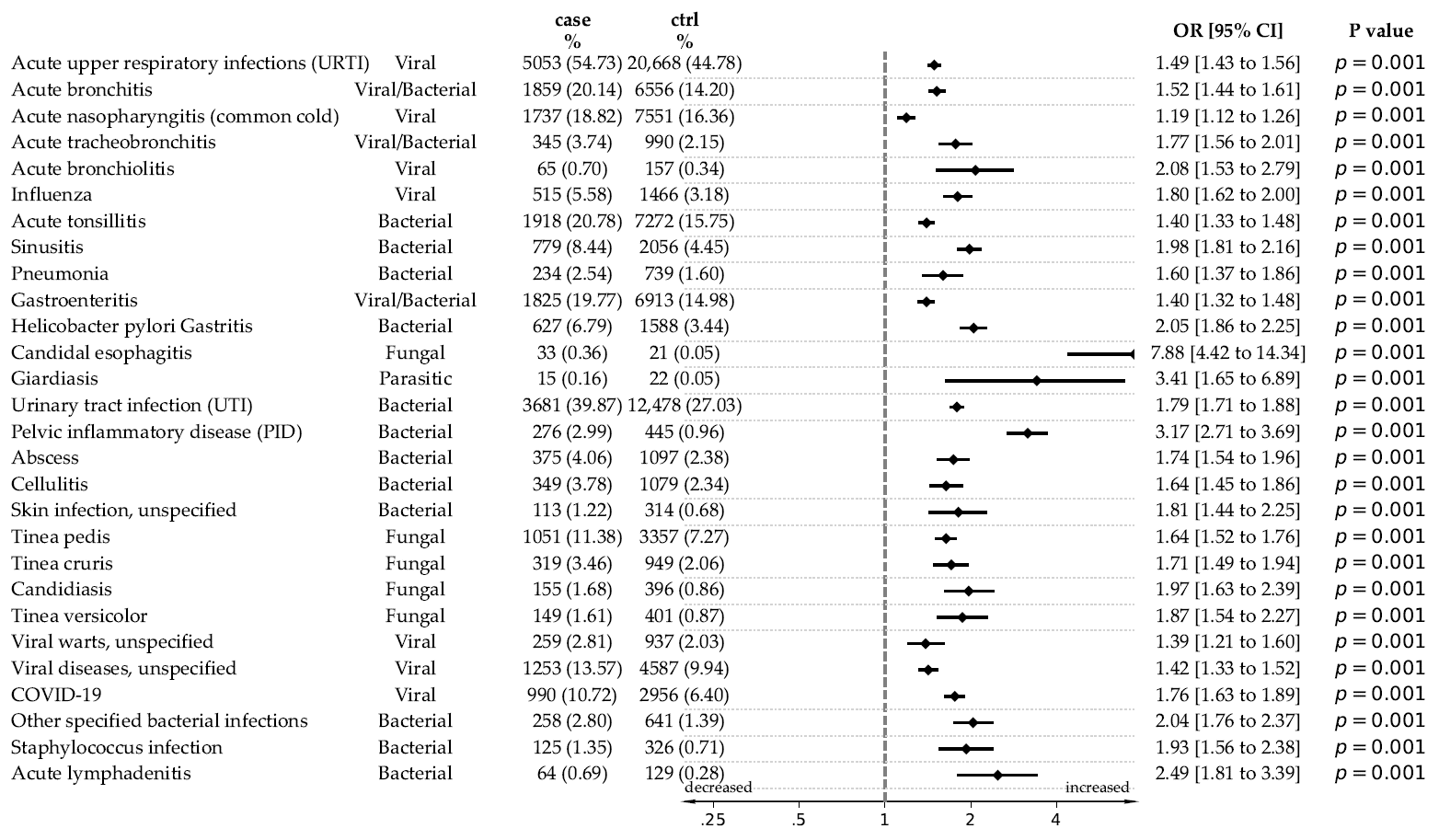
Notably, Fibromyalgia patients had nearly 8-fold higher rates of candidal esophagitis and more than 3-fold higher rates of pelvic inflammatory disease.
Importantly, the increased susceptibility extended across viral, bacterial, fungal, and parasitic infections, suggesting a broad physiologic pattern rather than a narrow pathogen-specific effect.
The analyses controlled for major demographic and lifestyle confounders, including age, sex, smoking, obesity, socioeconomic status, and healthcare follow-up structure. The pattern remained highly consistent across multiple categories of infectious disease.
These findings align with a growing body of biologic evidence suggesting immune and inflammatory abnormalities in fibromyalgia, including altered cytokine profiles, neuroinflammation, abnormal immune signaling, respiratory dysfunction, autonomic disturbances, and altered immunoglobulin levels.
The higher rate of infection is not an isolated signal.
Across multiple nationwide studies, we observed increased rates of allergic diseases, endocrine abnormalities, hand disorders, personality disorders, and distinctive orthopedic patterns in fibromyalgia patients.
Taken together, these findings suggest that fibromyalgia may involve complex interactions between the nervous system, immune system, endocrine system, inflammation, and behavior.
Large-scale electronic health records are uniquely suited for revealing these kinds of hidden biologic patterns.
Unlike traditional studies focused on isolated laboratory markers or single biologic pathways, nationwide longitudinal medical databases allow researchers to observe how diseases cluster across entire populations over many years:
which infections occur more frequently,
which diseases co-occur,
which symptoms precede diagnosis,
and how different physiologic systems interact over time.
The broader lesson extends beyond fibromyalgia itself.
Many medical conditions that remain poorly understood may have causes that span multiple biological systems rather than involve a single mechanism.
Large-scale human data may provide a new way to study these diseases.
Sometimes biology becomes visible only when millions of medical records are analyzed together.
References:
Increased Rates of Infectious Diseases in Fibromyalgia Patients: A Population-Based Case-Control Study.
Vinker-Shuster M, Magen E, Green I, Merzon E, Golan-Cohen A, Israel A.
Biomedicines 2024 Dec 12;12(12):2821.
doi:10.3390/biomedicines12122821.Allergic Comorbidities in Fibromyalgia.
Magen E, Merzon E, Green I, Magen I, Golan-Cohen A, Vinker S, Israel A.
Allergy Asthma Proc. 2025 Mar 1;46(2).
doi:10.2500/aap.2025.46.240080.Fibromyalgia and Hand Diseases: A Case-Control Study.
Magen E, Aamar S, Feldman V, Magen I, Merzon E, Israel A.
J Hand Ther. 2025 Sep 23(25)00115-2.
doi:10.1016/j.jht.2025.07.003.Endocrine Comorbidities in Fibromyalgia.
Magen E, Tolkin L, Aamar S, Magen I, Merzon E, Green I, Golan-Cohen A, Vinker S, Israel A.
Clin Endocrinol (Oxf). 2026 Apr;104(4):386-393.
doi:10.1111/cen.70063.Personality Disorders in Patients with Fibromyalgia.
Magen E, Geishin A, Weizman A, Magen I, Merzon E, Ashkenazi S, Vinker S, Israel A.
J Psychosom Res. 2026 Mar;202:112536.
doi:10.1016/j.jpsychores.2026.112536.